Friday, 30 January 2026

Reading and writing Christmas-themed poems with Year 7s: #writerinschool


Reading and writing Christmas-themed poems with Year 7s: #writerinschool

I’m really enjoying being Writer in Residence at St Gregory’s Catholic College, Bath.  As well as writing with students during lesson time, I also run a Creative Writing Club at Break and Lunchtime, one day a week.  When we’re writing poetry, I usually take in lots of photocopies of poems but today I took in a set of Christmas Stocking: Five Festive Poems for Children from Candlestick Press.

The poet Ben Bransfield, who is also a teacher (and has been named by The Poetry Society as a Teacher Trailblazer), put me on to sharing pamphlets with groups of students.  It’s a brilliant idea.  Candlestick Press pamphlets are beautiful objects to hold; the design and illustrations are very appealing and the paper quality is luxurious.   The poems themselves are always well-chosen and varied.  The five poems in Christmas Stocking have been selected by George Szirtes and include a new poem by him.

There’s a real sense of achievement in reading a whole ‘book’ in one sitting and themed pamphlets are so helpful for working on a specific topic.  These five poems provoked a lot of discussion about Christmas traditions and about what Christmas means to different people.  We also read two poems by UA Fanthorpe, What the Donkey Saw and I am Joseph.

I would say that these Candlestick poems will appeal to young people aged nine and above, possibly younger if they’re shared with an older reader.  These really are poems that demand to be read aloud so would be perfect for bedtime.

I read the poems with Year 7 students aged 11 and 12.  To warm us up and set our minds thinking, we started the session by talking about and writing a list of all the words we could think of to do with Christmas.  A long mish-mash list of words to do with the Nativity, rampant consumerism, hearty food consumption and excessively cold weather emerged.

Next, students read the Candlestick Press pamphlets silently before choosing one of the poems to read aloud to the group.   After reading and discussing, students began to write their own poems, using the published poems as a frame for their own work if they wanted to.
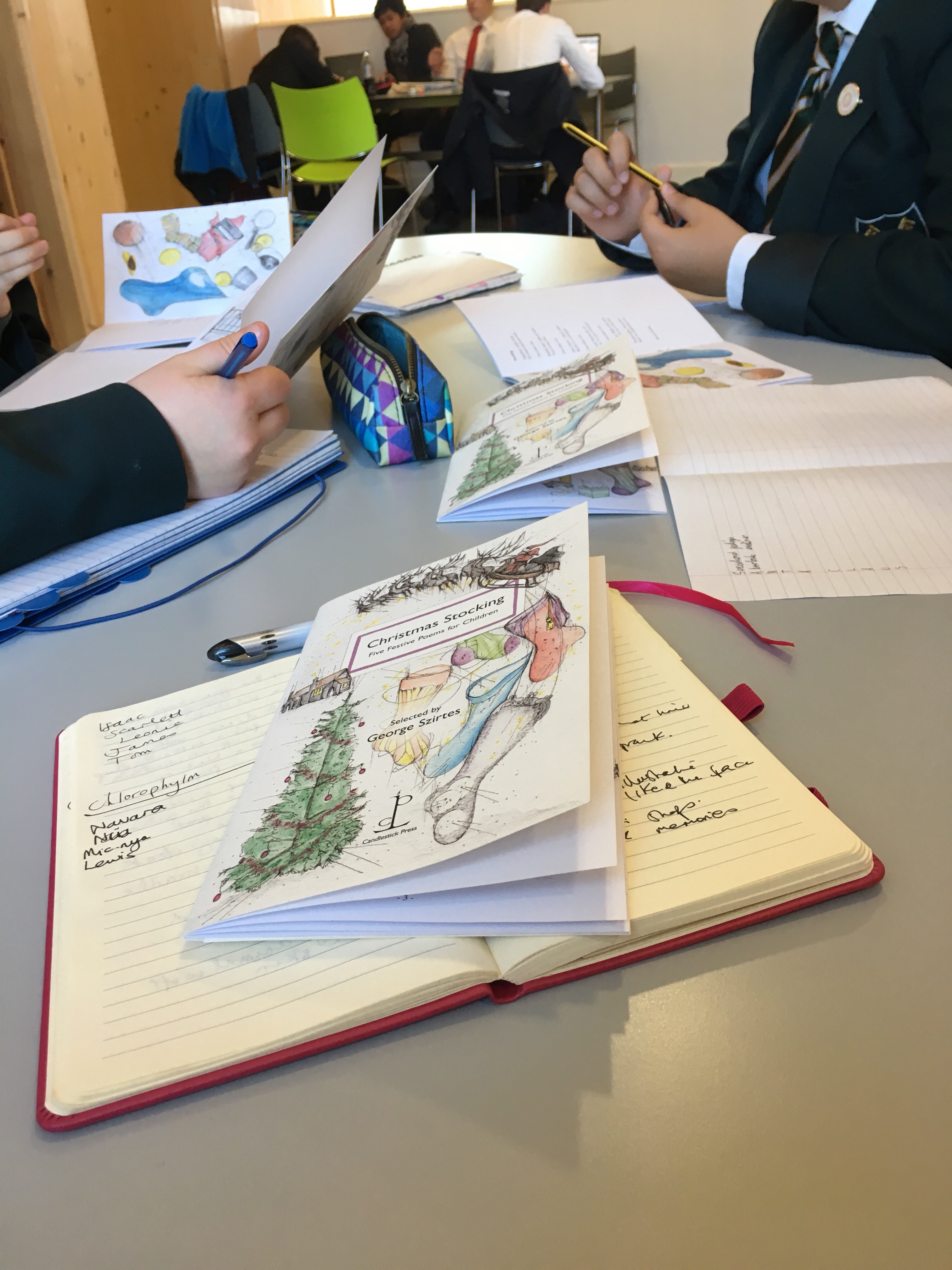
I asked students to be honest and to say if they didn’t like any of the poems but they were enthusiastic about them all.

Santa Claus by Gabriel Fitzmaurice, in the voice of a young child meeting ‘Santa’ for perhaps the first time, reminded one boy of when he was much younger and was apprehensive about meeting a strange man in a costume.  The group discussed how they had often been fearful of adults dressed up in costumes: clowns, mascots at sports matches, as well as Christmas figures.  They talked about the oddity of parents warning children of ‘stranger danger’ and then embracing the idea of someone coming into the house while everyone was asleep!  This reminded me that my own children (now young adults) used to leave their stockings on the landing, rather than at the foot of their beds, so that ‘Father Christmas’ didn’t actually come into their room while they were sleeping.

“The child is trying to be brave but is secretly scared,” one of the students said.  “I get that.  It’s still funny, though!”

Hello, Santa! This is me!
(Oh Dad, he’s awful hairy!
Oh Dad, don’t let him near me!
Oh, Dad, he’s awful scary!).
Not all of the students had been to a pantomime or knew what it was, but those that had liked the description of this particular Christmas tradition in At the pantomime by John Mole.  They  loved finding a stage curtain and pantomime Villain in the clever illustration accompanying the poem (illustrations by David&Rews, 2017).

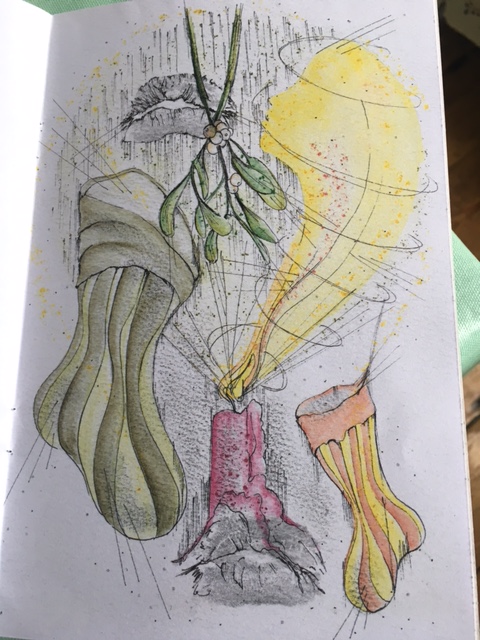
And the sharp-eyed students also spotted a pair of puckered lips and an upturned face within the candle smoke of the illustration accompanying the poem Mistletoe by Walter de la Mare (illustration by David&Rews, 2017).  “I like the elegant language in this poem,” said one 11 year old student.
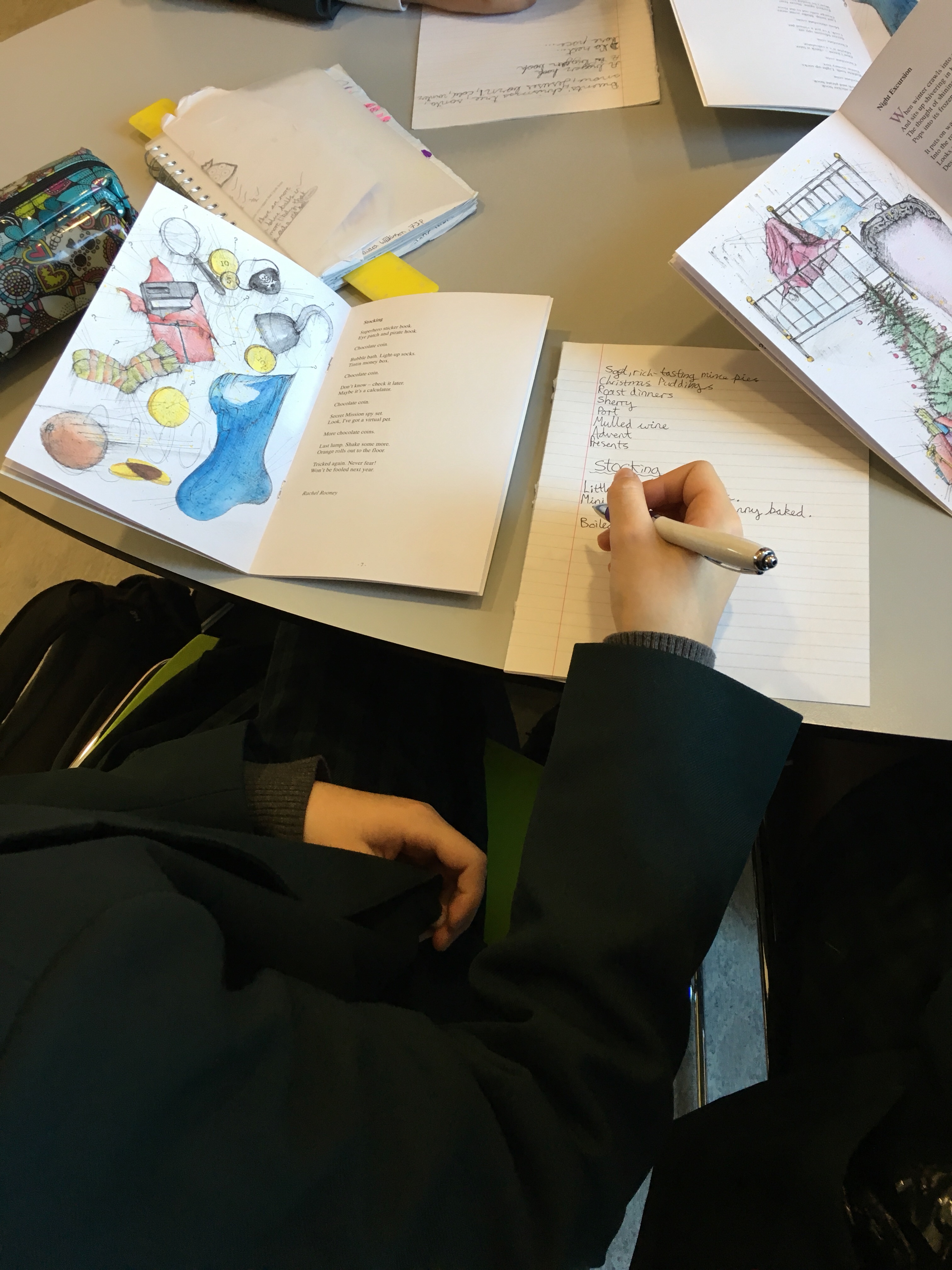
The group of students I was working with are sophisticated readers and writers.  They know that poems don’t need to rhyme but they really appreciated the rhymes of these poems.  One student, whose first language isn’t English, particularly liked Stocking by Rachel Rooney, which is about a child finding a jumble of exciting gifts – and one edible surprise in the toe! of a Christmas morning stocking.

Don’t know – check it later.
Maybe it’s a calculator.

“I love that bit!” the student said.

Several young people chose George Szirtes’ Night Excursion as their favourite.

“I love the idea of winter being a person,” one said.

“It makes you think of that time of year when it’s really cold and when shop windows are full of fun things to look at,” said another.

Not all of the students in my group have English as their first language and not all of them are from families that share all of the traditions featured in these poems.  While talking about this, and comparing notes about what different families do each Christmas, we learned about some of the Christmas traditions from different countries.  One girl talked about the Romanian tradition of children leaving lace-up boots on the stairs on 6th December, the Feast of  St Nicholas, for example.  Perhaps this is something that Candlestick Press could consider for another year!

The young people I worked with really enjoyed reading Christmas Stocking and I think it would make a wonderful gift.  With the sale of each pamphlet, Candlestick Press makes a donation to UNICEF.  More details on the Candlestick Press website.

Thinking about sound and other senses. #writerinschool


Thinking about sound and other senses. #writerinschool

I’m coming to the end of my first term as Writer in Residence at St Gregory’s Catholic College, Bath.  As you know, I’ve been using this blog as a place to document my work there.  Previous posts include Beginning to Write Poetry With Secondary School Students,  Reading and Writing Poems about Where I’m FromNational Poetry Day, and Poetry Workshop Ideas (using  the poem The Long Holidays by Esther Morgan).

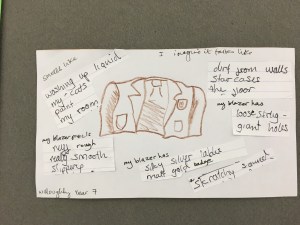
In recent weeks, students have begun to think about using all five senses in their writing.   An easy way into this, and something I’ve done before when I’ve worked with other groups, is to use an object that all members of the writing group have access to – in this case their school blazer.  Students were challenged to describe their blazer in detail using all five senses.  The St Gregory’s blazer is dark green but students had to come up descriptions that would really bring the object to life.  There have been some excellent examples:

my blazer is as green as a Christmas Tree

as green as an avocado

as green as crocodile skin

Describing how the blazer felt, one student wrote

its lining is as slippery as a snake’s underbelly

the outside is as rough as burnt toast

As the descriptions grew, we discussed what was happening.  Not only were the objects being vividly described, we were also learning something about the person who owned the blazer:

My blazer smells of Charlie’s house

My blazer smells of chicken pie

it smells of my cats

My blazer tastes of the wooden door that it hangs on every evening.

Some students chose to draw their blazers as well.

In order to write about the sound a blazer makes, students had to move around, shake their blazers to make the items in their pockets jangle

it sounds like bells

it sounds like a tambourine

and they rubbed their sleeves against their ears and brushed the fabric of their blazers with their hands so as to really pay attention to the sounds their blazer could create.

So this led us to think more about sound.  Students know that I’ve written radio plays as well as poetry so they want to try writing some plays of their own.  We began by finding out if we could write down every sound we could hear in the study area where we were sitting, setting the timer for one minute and listing all of the sounds.  We noticed that some people are more observant, or simply hear more, than others.  Also, people hear different sounds.  We compared notes.  Then we tried to imagine what we would be able to hear if we were at a different location in the school – in the reception area, for example. Then we imagined ourselves further and further away, and, finally, students were told they had a super power and could travel to the furthest place they could imagine.  What could they hear?

Again, it was interesting to note how different students’ responses were.  Some young people imagined themselves to the edge of the town or the edge of the country.  Others reached faraway planets and galaxies.

I Sat in the Quiet Classroom, a poem I wrote with mixed aged Primary School, published in the All Write anthology, came out of this exercise.  I wrote about that here.

Next, we read some short extracts from radio scripts.  I wanted students to see how scripts are laid out.  With more time, we will try to listen to radio plays as well.  We read the extracts aloud, with as many students as possible taking on a role.

Next, it was time for students to begin to write their own short scripts.  I set out a scenario for two characters – a strict teacher suspects that a student (who always seems to be in trouble) is chewing gum.  What happens?

Students wrote their scripts then acted them out to the group.  I was amazed at how quickly they worked, at how clever and sassy their students were, and how easily duped their teachers were!

This has brought you up to date with what we’ve been doing since September.  My days at St Gregory’s are hard work – I feel like a melted candle by the end of the day! – but I’m thoroughly enjoying working with so many talented writers and artists one day a week.

Reading and writing poems about ‘Where I’m From’. #writerinschool


Reading and writing poems about ‘Where I’m From’. #writerinschool

As I’ve mentioned before, I’m using this blog as a place to keep a record of my residency at St Gregory’s Catholic College, Bath, a non-selective comprehensive school for young people aged 11 – 18.  I go into school one day a week, run a creative club (open to any student) during break and at lunchtime, and work with small groups of students from Years 7 – 9 (aged 11- 14) during their timetabled English lessons.  I also correspond with students about their creative writing via school email, and I’ve worked with a few sixth formers on their UCAS personal statements, as well as the Creative Writing elements of their A Level English Language and Literature course.  You can find my posts on this blog by using the search terms ‘writer in school’ and ‘working as a writer in a school’.

Over the last three weeks, we’ve been reading and writing poems about ‘Where I’m From’.  I was inspired by this great post by Jean Atkins and I thought that, as it’s still early in the new school year, and lots of students, as well as me, are new to the school, this would be good way of everyone getting to know each other a little bit more.

To begin with, we read Lament for Syria by Amineh Abou Kerech, aged 13, who won First Prize in this year’s Betjeman Poetry Prize  and Where I’m From by Melanie Poonai, who was a winner in the 2007 Foyle Young Poets of the Year.

Students warmed to poems by writers who are close to their own age.  We talked about how Amineh’s poem made us think about Syria in a completely different way from how the country is usually portrayed on news reports.

I am from Syria
From a land where people pick up a discarded piece of bread

We also talked about how poetry allows us to say a lot using few words, and how it breaks the rules of prose.

From: after you, aunt; as you wish, uncle; with pleasure, sister…
From a place which endured, which waited, which is still waiting for relief.

We liked the way Amineh used direct speech here, and thought about using it in our poems.  One student used something a grandparent often says, to come up with the great line “I come from whatever the weather blows our way.”  Another wrote the line “From: sad since my dog died.”

Some students chose to write a lament, like Amineh, about a place they loved very much and missed.  Others followed Melanie Poonai’s use of anaphora to write an ‘I am from..’ poem.

I am from a life filled with colour,
From the chocolate brown that is my skin.
I am from the sunshine yellow of my mother’s laugh,
From the red and white of my brother’s favourite football shirt.

Some students also used colour in their poems, others tried using the sense of smell and sound to describe themselves and their lives.

We developed the theme of poems about ourselves by reading another winning poem from this year’s Betjeman PrizeSix Haikus From Mangalore by 10 year old Shanelle Furtado.  Most of the students I was working with had already heard about haikus and had written some at their primary schools.  What we particularly liked about Shanelle’s poem was the way she’d used six linked haikus which gave us scope to say more, either about a particular place, ie Mangalore,  or about another subject (later, one student wrote a really good set of haiku about different fruit, for example).

But inside the house
The bafat masala cooks
Home in Mangalore

This poem also encouraged students to write about their own heritage, either about the country where they were born or where their family are from, and to use specific language to describe food, culture or customs, without the need to explain what it meant – we could all work that out from context.

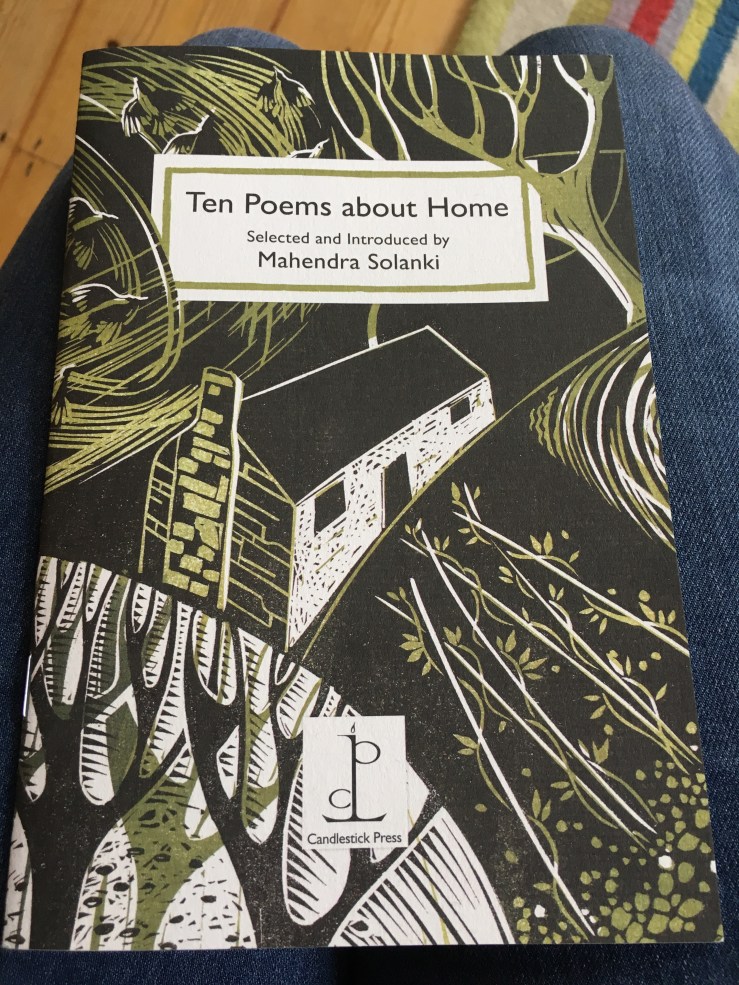
Inevitably, some students race ahead, and seem to devour poems and produce them in large number!  I was glad to have copies of Candlestick Press’ Ten Poems about Home to hand, to give to students to read.

One young writer I gave this pamphlet to, read it silently from cover to cover then told me that their favourite poem in it was Tony Harrison’s Long Distance.  The student’s reaction reminded me of a post I wrote a while ago about making all poetry books available to young people, and not restricting their reading to ‘poetry for children’.

The poet Ben Bransfield, who is also a teacher and a Poetry Society Teacher Trailblazer (read Ben’s (and others) Top Tips for Teaching Poetry)  has spoken about  the benefits of bringing a wide range of poems into school.  Ben is also a big fan of using poetry pamphlets in teaching sessions, since students are able to read the entire ‘book’ in one session, giving them a great sense of completion and ownership.  At some point, I will invite Ben to comment further on this and I would like to design some sessions around a collection of different pamphlets.

We rounded off our writing about ‘Where I’m From’ by reading Kim Moore’s My People and Liz Berry’s The Sea of Talk.  Students talked about the way you can have a strong sense of who you are and where you’re from, without knowing all the facts for certain.  They liked the way Kim imagines who her people are.  With Liz Berry’s poem, we talked about dialect and accent, and how the way we speak, the words we use, are as much a part of who we are as the way we look.

Please feel to add links to more poems that would work with this theme.

National Poetry Day at St Gregory’s #writerinschool


National Poetry Day at St Gregory’s #writerinschool

Popping in briefly to say I’ve had a happy but busy poetry week.  I was in St Gregory’s all day Wednesday and most of Thursday (National Poetry Day) and I stayed for their Open Evening on Thursday so wasn’t home until nearly 10pm.

I think that my school residency is going well, so far!  I’m really enjoying working with students from different years in small groups.  I love selecting poems to read and creating writing exercises based around them.  We’ve been continuing to write around ideas about ‘Freedom’ as that was the National Poetry Day theme this year.  I’m planning another theme for the next two weeks of writing.

Lovely things that happened this week included a supply teacher coming to my lunchtime writing club to write poems alongside students – the teacher said that poetry “was their weak spot” and they wanted ideas to take into class as well as to help them with their own writing.

It was very powerful for an adult to write alongside students, to share their hesitancy and openly talk about finding poetry difficult and to read out what they’d written.  It made us all think about writing as an activity that we continue to strive to be better at, and that sharing our work and talking about it is a good thing, and that it’s ok to feel a bit nervous about it.  I am witnessing at first hand how a writing residency in a school benefits a wider community.  I’m so grateful to the teacher for coming to my lunchtime club!

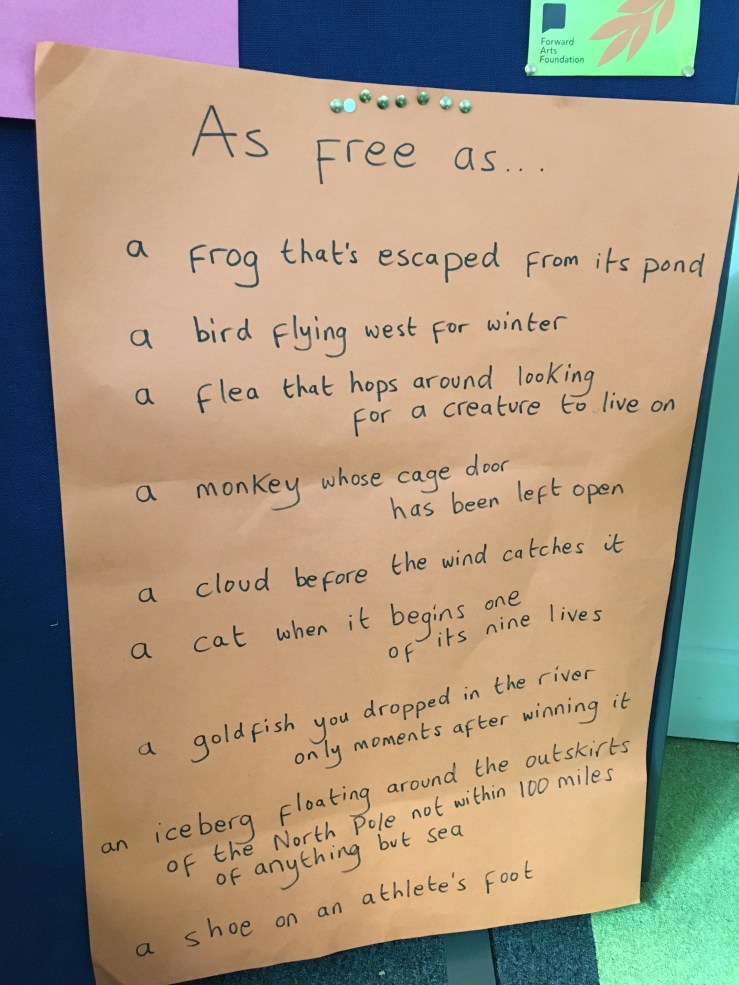
Another lovely thing that happened was that one of the English teachers took my ‘As free as a …’ group poem (really a list of similes about freedom that I’d gathered from working with several groups) into their lesson and used it to write with their class.

Students wrote (and drew) on sheets of unlined A3 paper and we pinned up these ‘freedom’ poems along the corridor.  Later, during Open Evening, visitors wrote their own ‘freedom’ poems on cut out birds or leaves and attached them to the wall. So a free-flowing display has taken shape, with our shared resources and different students work available for everyone to read.  I love the way the whole department has got behind the idea of my residency and that so many students and visitors have been able to participate in this exciting venture in a short space of time. I love being part of it!


Poetry Workshop Ideas: The Long Holidays by Esther Morgan #writerinschool


Poetry Workshop Ideas: The Long Holidays by Esther Morgan #writerinschool

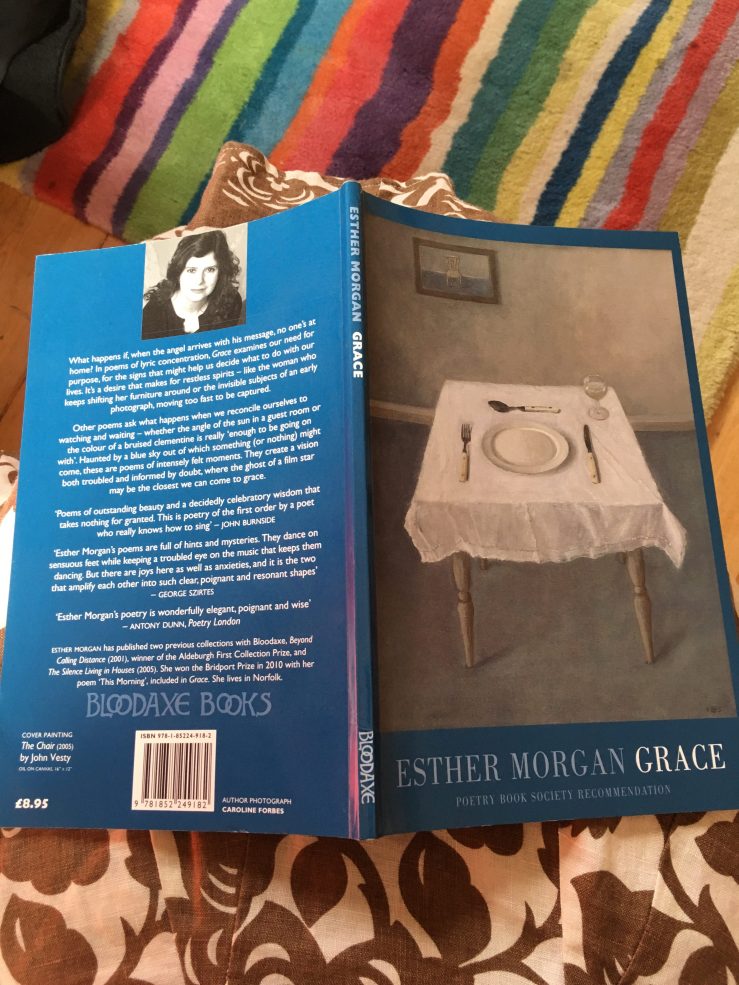
I enjoy browsing through poetry books on the look out for poems that I think will work well in a workshop.  As I mentioned before, the theme for National Poetry Day this year is ‘Freedom’ so I’ve been looking for suitable poems to take into St Gregory’s Catholic College where I’m working as Writer in Residence.  I found two good ones in Esther Morgan’s 2011 Bloodaxe book Grace. They are As I Walked Out and The Long Holidays (see below).

Something I’ve noticed about working with novice poets is their fondness for using ‘poetic language’ in their poems.  Grass has a tendency to be “emerald green”, the sea often “shimmers magically”, “clouds drift softly,” and so on.   Sometimes this kind of writing spoils my enjoyment as a reader, firstly because I’ve read those phrases many times before and, secondly, because I sense that writers are trying to conform to their idea of how a poem should be, rather than trying to convey what they really mean.

I think this is inevitable if a writer hasn’t read much modern poetry.  For this reason, I always bring lots of poems (by many different writers) into my workshops, so that participants have the chance to bring themselves up to date (to some extent) with what is currently being published.  In this way, new writers are offered more options and ideas about how they might go about writing a poem.

Esther Morgan uses simple, clear language so she is good poet to read if I find myself indulging in too much magical shimmering, and she’s a good poet to share with others who find themselves softly drifting a bit too fluffily.

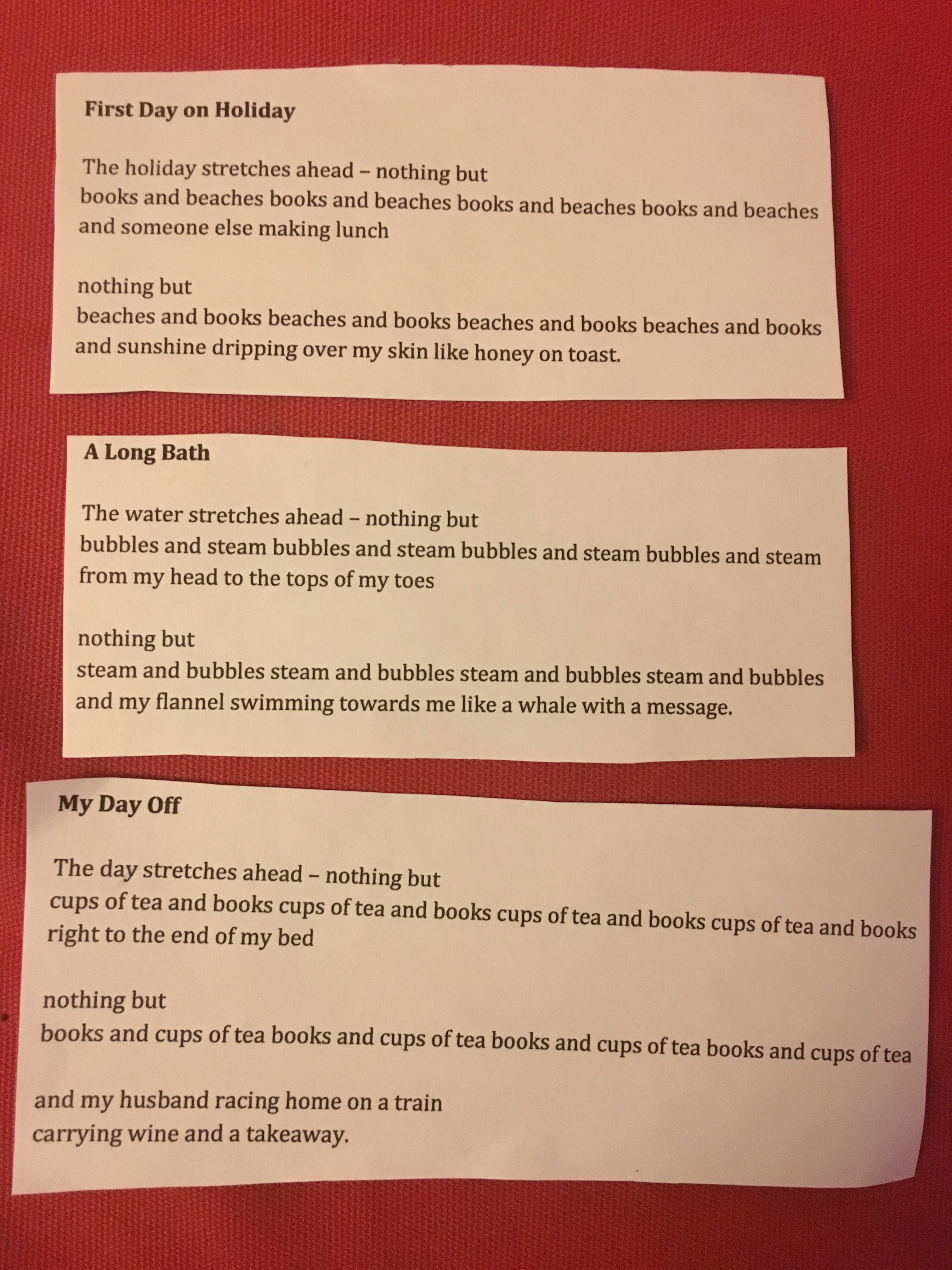
In the two poems chosen here, adjectives and adverbs are sparse (can you spot any?).  The Long Holidays has no punctuation other than one capital letter at the beginning, one full stop at the end of the poem, and one dash on the first line.  It is a short poem, only seven lines long, so an extremely portable poem to carry into workshops.

I shared The Long Holidays with students aged 11 – 14 and it is no exaggeration to say that several faces lit up when they saw that it is possible to write a poem with hardly any punctuation!  They were fascinated by the line-breaks and the unequal length of lines.  We read the poem aloud several times (another advantage of using a short poem) and experimented with saying the poem in one breath or pausing at line ends.  We talked about using the space at the end of a line and stanza breaks as kinds of punctuation.

Other ways to use this poem would be to blank out the title or blank out sections of each line and invite students to speculate about the missing words.  With one group, students read the poem a few times and then tried to recite it from memory.  This made us pay attention to every word and listen to the poem’s rhythm.

We talked about the mood of the poem, how it made us feel, how we thought the poet was feeling, what it was about.  After a short discussion, students wrote their own versions of the poem, stealing the first line, if they wanted to, and trying to include one simile on the final line.

I shared some of my attempts with the group, included below:

The students wrote some interesting variations of poems.  Among my favourites was a poem about St Ives (in Cornwall) with the line “nothing but seaside and pies seaside and pies seaside and pies.”  Another poem was about an uneventful kind of teenage day “nothing but spots and scabs spots and scabs spots and scabs.”

As I Walked Out is another Esther Morgan poem that’s worked well in workshops this week.

Don’t forget there are more poems around the theme of ‘Freedom’ on the National Poetry Day website.  I think my favourite is Sophie Herxheimer’s  Of course I am Maid Marian, Who else is there to be? Which is your favourite?  Do you have other  ‘Freedom’ poems to recommend?

Beginning to write poetry with secondary school students #writerinschool


Beginning to write poetry with secondary school students #writerinschool

I’m using this blog as a notebook to record my time working with students at St Gregory’s Catholic College, Bath, as Writer in Residence.  I’ll use the tag ‘writer in school’ so you should be able to find my posts here by using that search term.  It’s still early days in my residency, I’m now in my fourth week although I’m actually only ‘in residence’ one day a week.   Between weekly visits, I keep in touch with students and staff by school email.

It’s important to mention that I’m being hugely supported by staff in the English Department of the school, who have organised rooms and spaces for me to work from and arranged for students to take time out of their scheduled English lessons to write with me.  Anyone who understands the complexities of classroom availability and a school timetable, and the obligation to write to parents and carers to ask their permission for students to take part in an extra curricular activity, will understand the extra admin involved in this kind of venture.  I’m very grateful to staff for doing this work and for making me feel welcome and supported in the school.

Teachers are sharing information about me via their tutor groups and through word of mouth so that students know which day I’m in school and where they can find me.  This means that students are now coming to see me at break and lunch time, to ask questions about writing and to take part in on the spot writing sessions.

As free as a…

Last week, I saw small groups of students from Years 7 – 9, who are aged from 11 to 14.  The previous week, I’d also spoken to, and done some writing with, a few students from Years 10 and 11 (aged 14 – 16).  The writing I’m sharing in this post features work from all of these students.

It’s National Poetry Day on 28 September and the theme this year is ‘Freedom’ so I began by asking students to finish the expression “As free as a …”

The majority of people answered with the simile “As free as a bird.”  So we talked about whether that was a good expression, whether it was true – yes, birds are free to cross borders, they don’t need passports, they don’t have to go through passport control, but are they free when we think about pollution, climate change, their habitats being destroyed, and so on.

Sharing my notebook with students

I shared with students how I had begun to think about writing about freedom.  Like many of them, the first expression that had come into my mind was “as free as a bird” so I had written that down in my notebook.  Then I’d set a timer on my phone and written freely for three minutes. I shared the results of this exercise with students.  My aim here was to show them how I write and to show them that I sometimes write quickly and don’t always keep everything I’ve written!  In fact, I discard much more than I keep.

Next, it was the young people’s turn.  I set my timer and gave them five minutes to write. I told them that my writing had started as a list of things (that I could think of that were free), so a list might be a good way for them to start.  I said it would be fine if they just wrote a long list and it would be fine if they went back to add to their list whenever they wanted to during the five minutes.

After their writing time was up, I asked students to read out one or two lines they liked – if they wanted to.  I tried to make sure that nobody felt they were being forced to read out anything they’d written.  I was very impressed with how kind and encouraging the young people were to each other and to me!  Almost all of the students were happy to share what they had written with the group.

I worked with about forty different students in all and took one or two lines from as many as I could to add to the beginnings of a group poem – really a composite list of the day’s work.

Here are the results of our labour.  I’ve left the poem on display in school and I hope students, staff and visitors to the school are reading it during my absence.  I will find out when I am next in!

Thanks to staff and students at St Gregory’s Catholic College, Bath, for all of their contributions to this post.

My first weeks as a Writer in Residence in a school #writerinschool


My first weeks as a Writer in Residence in a school #writerinschool

This post was originally published on my WordPress blog, written when I was Writer in Residence at St Gregory's School in Bath (2017-18). I'm going to re-publish my #writerinschool posts here.

I’m going to be using this blog as a kind of diary and a place to keep notes about my work as a Writer in Residence at St Gregory’s Catholic College in Bath.  I won’t use students’ real names or photographs and I won’t do or say anything which would put any young person at risk.  I’ll use the pronoun ‘they’ rather than ‘he’ or ‘she’ to respect students’ privacy.

My first week involved safeguarding training, learning to use the school email system, familiarising myself with the school campus and working out the quickest way to travel to and from the school.  I’d really hoped to be able to use public transport – always my favoured mode of journeying – but a train and a bus are prohibitively expensive, not to say time-consuming, so I’ve decided to take my car.  At some point in the future, I may well rant about the cost of public transport in West Wiltshire and North East Somerset.  It’s especially ridiculous and unfair that students aged 16+ cannot use their Young Person’s Railcard during peak times so have to pay full fare to travel to their place of study!  But that’s for another post.

I talk about my ‘first weeks’ but, as I’m only in school once a week, it has only been two days, so far (I admit to being keen and coming in for two Teacher Training days so that I wouldn’t look completely idiotic and clueless when I first started to meet students).

Gradually, gradually, students are learning where I am and have started to email me and pop in to see me.  One Year 7 emailed me a poem they wrote, one Year 13 asked me for help with their Personal Statement for a UCAS form, another student wanted to quiz me about writing scripts, another about short fiction, and two more joined in with a free-writing exercise.

Today I looked at the school register with one of the English teachers and we’ve worked out a plan for me to run some poetry writing workshops with a selection of students next week.

At the moment, I’m in school but I’m hovering around its edges.  I don’t have my own classroom, I don’t have playground duties, I don’t spend a lot of time in the staff room.  I sit in a study area in a busy corridor.  I watch students changing classrooms, moving around the school on their way to lessons and break.  I eavesdrop on chatter, I say hello.

“Are you the writing person?” a student asked.  “Yes! Hello!”  “Hello!” and then they were gone, into the classroom to start a lesson.

At the moment, I’m with the English Department.  Everyone is friendly and kind.  I’ve been offered cake, biscuits, fudge, cups of tea, coffee, help with using the printer and photocopier, help with knowing who to send an email to.  Between lessons and at break, teachers flurry by, collecting papers, gathering teacups, handling piles of books, smiling, admonishing, laughing, weaving in and out of streams of students.  Somehow, nobody collides with anyone else.

Sometimes students stop to talk to me and work with me.  I hope this happens more and more.

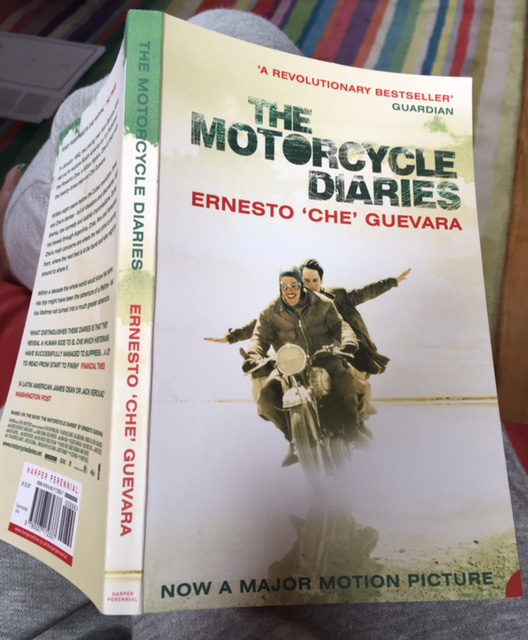
When it’s quiet, between lessons, I make notes in my notebook – I’m thinking about the theme of ‘Freedom’ for National Poetry Day and trying to write some new poems.  I’m also reading The Motorcycle Diaries by Ernesto ‘Che’ Guevara, as it’s one of the set texts for English Literature and Language ‘A’ level and I hope to be able to help students when they come to write their creative responses to this.

The Motorcycle Diaries are Che Guevara’s notes and diaries from the 1952 journey across South America he and his friend Alberto Grenado undertook in 1952, eight years before the Cuban revolution.

So sometimes I’m in Bath, sometimes I’m on the road with Che and Alberto, thinking about my next meal, hoping I don’t lose my balance and crash headlong down a narrow mountain path.

Adios amigos, until next time.